
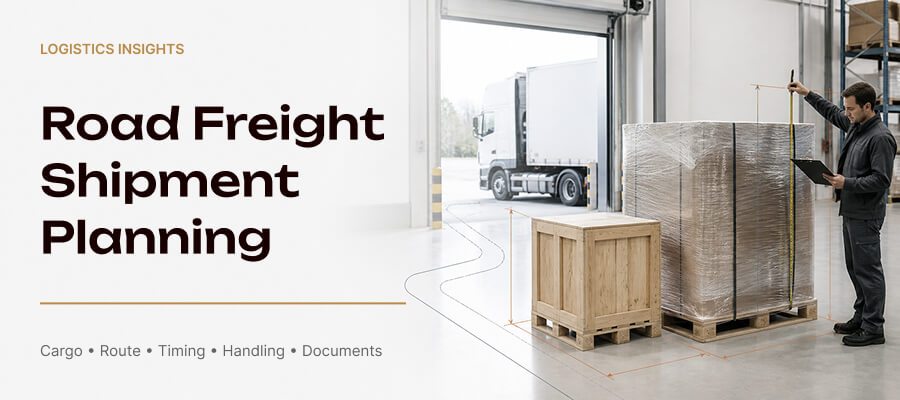
A road freight shipment can look straightforward: collect the cargo at one address and deliver it to another. In practice, the route is only one part of the planning process.
The logistics provider also needs to understand what is being transported, how the cargo is packed, when it will be ready, what equipment is available at both locations, and whether any special handling or documentation is required.
Providing these details at the beginning helps the provider select a suitable vehicle, assess the schedule and prepare a more accurate quotation. It also reduces the risk of discovering an operational restriction after the vehicle has already been assigned.
Why a Complete Shipment Brief Matters
Two shipments travelling between the same cities may require entirely different solutions.
A standard pallet that can be stacked and loaded through a warehouse dock is not handled in the same way as a tall machine, temperature-sensitive product or non-stackable automotive component. The vehicle, loading method and usable cargo space may all change.
Timing matters as well. A flexible delivery window allows more planning options than a shipment that must connect with a scheduled flight or arrive before a production line stops.
This is why a useful transport request should describe the entire operation rather than provide only the route and total weight.

1. Exact Pickup and Delivery Locations
The provider needs the complete addresses for every pickup and delivery point.
A city name or postal code may be enough for an initial estimate, but final planning normally requires:
- the full street address;
- the number of pickup and delivery locations;
- warehouse opening hours;
- booked loading or unloading slots;
- local contact details;
- site access instructions;
- any restrictions affecting large vehicles.
Access conditions can materially affect vehicle selection. A full-size articulated truck may be appropriate for the cargo but unsuitable for a location with a narrow entrance, restricted turning space or a low access gate.
For multi-stop shipments, the required order of collections and deliveries should also be specified. Changing that order later may affect the route, loading sequence and delivery schedule.
2. Cargo Quantity, Weight and Dimensions
“Three pallets” is not yet a complete cargo description.
The provider should receive the dimensions and weight of each handling unit, not only the total shipment weight. A practical specification includes:
- number of pallets, crates, boxes or other units;
- length, width and height of each unit;
- gross weight of each unit;
- total gross weight;
- whether the stated dimensions include packaging;
- whether any part of the cargo overhangs its pallet;
- whether the units can be stacked.
These details determine how much floor space and payload capacity the shipment requires. They also help identify cargo that may exceed standard vehicle limits or need a special transport arrangement.
European rules establish maximum authorised weights and dimensions for heavy commercial vehicles. Oversized or unusually heavy cargo may therefore require additional route checks, permits or different equipment. The European Commission’s overview of vehicle weights and dimensions provides the relevant regulatory context.
Accurate measurements are especially important for non-stackable cargo. Even a relatively light shipment may occupy most of a trailer if nothing can be placed above or beside it.
3. Packaging and Stackability
The way cargo is packed affects both loading and transport safety.
The provider should know whether the goods are placed on standard pallets, packed in crates, secured in racks or transported as loose machinery. Any weak surfaces, protruding elements or restrictions on placing other cargo nearby should be disclosed.
If a unit is non-stackable, this must be stated clearly. The same applies when only limited stacking is permitted—for example, when one lightweight pallet may be placed above another but heavier cargo may not.
Photographs can be useful when the packaging shape is unusual or difficult to describe. They allow the provider to check the footprint, lifting points and likely securing requirements before collection.
This type of preparation was particularly important in Savchuk International’s time-critical air freight feeder operation, which involved 83 non-stackable pallets and required coordinated vehicle capacity and loading slots.
4. Cargo Type and Special Handling Requirements
The commercial name of the product is useful, but the transport-relevant characteristics matter more.
The request should identify whether the cargo is:
- fragile or sensitive to vibration;
- temperature-controlled;
- high-value;
- non-stackable;
- liquid or liable to leak;
- unusually tall or heavy;
- sensitive to moisture or direct sunlight;
- classified as dangerous goods.
Temperature-controlled cargo requires a target temperature and an acceptable range. It should also be clear whether active temperature control is needed throughout the journey and whether temperature records are required after delivery.
For an example involving a defined temperature range and a strict delivery schedule, see the temperature-controlled express shipment to Spain.
Dangerous goods require additional information, including the UN number, proper shipping name, hazard class, packing group where applicable, quantity and packaging type. The current international requirements are set out in ADR 2025, published by UNECE.
The logistics provider should be informed about these requirements before confirming the vehicle—not when the driver arrives for loading.

5. Loading and Unloading Conditions
The provider needs to know how the cargo will enter and leave the vehicle.
Useful information includes:
- whether a loading dock is available;
- whether loading is possible from the rear, side or top;
- whether a forklift is available at both locations;
- whether the vehicle needs a tail lift;
- whether a pallet jack is required;
- whether the driver is expected to assist;
- how long loading and unloading are expected to take.
A shipment may fit inside a standard trailer but still require a different vehicle because of the loading method. For example, machinery loaded by crane may require roof access, while a location without a dock or forklift may require a vehicle with its own tail lift.
The shipper should also explain whether the cargo will be ready and packed when the vehicle arrives. Waiting for unfinished production, documentation or packaging can disrupt a tightly planned route.
6. Collection and Delivery Timing
Transport planning requires more than a preferred pickup date.
The provider should receive:
- the earliest time the cargo will be ready;
- the latest acceptable pickup time;
- the requested delivery date and time;
- any fixed warehouse appointments;
- the consequences of missing the delivery window;
- whether weekend or public-holiday operations are possible.
It is important to distinguish between a preferred delivery time and a strict operational deadline. A factory appointment, airport acceptance window or scheduled production stop may require a different solution from an ordinary business-hours delivery.
Distance alone does not determine transit time. Loading, border procedures, traffic restrictions and legally required driver breaks must also be considered. EU rules set limits on professional driving periods and require defined breaks and rest periods. The European Commission’s guidance on driving and rest times explains the applicable framework.
For urgent transport, the logistics provider may consider options such as team driving, direct transit or a different vehicle type. Their feasibility depends on the route, cargo and deadline.
7. Documents and Customs Status
The required documents depend on the cargo, route and countries involved.
For international road transport, the shipment information commonly includes:
- commercial invoice;
- packing list;
- transport instructions;
- CMR consignment note details;
- export or import documents where applicable;
- commodity or customs classification information;
- dangerous-goods documentation;
- certificates required for regulated products.
The CMR Convention provides the legal framework for many contracts involving international carriage of goods by road. The official convention text is available from UNECE.
The shipper should clarify whether the movement is entirely within the EU or crosses a customs border. If customs clearance is required, the parties should agree in advance who will prepare the declaration, which customs office will be used and whether the vehicle must stop at a specific location.
Incomplete or inconsistent documents can delay a shipment even when the vehicle and route have been planned correctly.
8. Cargo Value, Insurance and Security Expectations
Declaring the cargo value helps identify whether additional security or insurance arrangements should be discussed.
The provider should know if the shipment requires:
- additional cargo insurance;
- secure parking;
- restricted disclosure of shipment details;
- vehicle tracking;
- route-specific security measures;
- documented handover procedures.
High-value cargo does not automatically require the same solution in every case. The appropriate measures depend on the product, route, delivery location and contractual responsibilities.
Cargo owners should review the applicable transport terms and insurance coverage rather than assume that every type of loss or damage is covered without limitation.
9. Communication and Tracking Requirements
Not every shipment requires the same level of communication.
For a routine delivery, milestone updates at collection and delivery may be sufficient. A time-critical shipment may require more frequent status reports, immediate escalation of delays and confirmation after each loading point.
The transport request should specify:
- who should receive updates;
- which communication channel should be used;
- which milestones must be reported;
- whether live tracking is required;
- who can approve changes during transit;
- who should be contacted outside normal business hours.
Clear responsibilities are particularly useful when several parties are involved, such as the shipper, consignee, customs representative, warehouse and freight forwarder.

What Happens After the Information Is Submitted?
Once the provider has a complete shipment brief, the operational assessment can begin.
The provider can review the cargo against available vehicle types, check loading compatibility, assess the route and timing, identify documentation requirements and clarify any unresolved risks.
Only then can the quotation reflect the actual transport requirement rather than a set of assumptions.
A complete request does not guarantee that every preferred condition will be feasible. It does, however, allow potential issues to be identified before collection and gives both parties an opportunity to agree on a workable solution.
Savchuk International’s freight transportation services include pickup coordination, route planning, vehicle selection, shipment tracking and delivery within agreed timelines.
Road Freight Shipment Information Checklist
Before requesting a quotation, prepare the following information:
- complete pickup and delivery addresses;
- requested dates and time windows;
- number of loading and unloading points;
- cargo description;
- number and type of handling units;
- dimensions and gross weight of each unit;
- total shipment weight;
- packaging type;
- stackability;
- loading and unloading equipment;
- temperature or handling requirements;
- dangerous-goods classification, if applicable;
- customs status and available documents;
- declared cargo value;
- tracking and communication expectations;
- photographs for unusual cargo or packaging.
If some details are not yet confirmed, identify them as provisional. It is better to show what remains unknown than to provide measurements or timings that may later prove incorrect.
Prepare the Shipment Before Choosing the Vehicle
Vehicle selection is an outcome of shipment planning, not its starting point.
The right solution depends on the relationship between cargo dimensions, handling conditions, route, deadlines, site access and regulatory requirements. Supplying this information early helps the logistics provider evaluate the shipment realistically and reduces avoidable changes later.
If you are preparing a road freight shipment in Europe, contact Savchuk International with the available cargo and route details. The team can review the requirements and discuss an appropriate transport solution.
Planning a Shipment Across Europe?
Discuss your logistics requirements directly with our team.